Exhibition · Culture Narrative
Flows on Porcelain:
Civilizations in Motion and the Making of a Global Imagination
From its origins, porcelain travelled across regions, absorbing, translating, and reshaping global visual languages.
Through eight works spanning five centuries, this exhibition traces material importation, aesthetic adaptation, courtly hybrid painting, regional trade, urban consumption, political communication, and contemporary co-creation. Porcelain emerges as both a medium of dialogue and a maker of global imagination.
Porcelain loves to travel! 🌍✈️
Just like you might bring back a souvenir from a trip, porcelain has been collecting patterns and colors from all over the world for 500 years. In this exhibition, we will see how Chinese porcelain made friends with ideas from Europe, Thailand, and beyond. It shows us that sharing ideas makes art even more beautiful!
This narrative, 'Flows on Porcelain', investigates the transcultural agency of ceramic objects.
By examining eight paradigmatic works, we map the trajectory of aesthetic hybridization—from the appropriation of Persian motifs to the synthesis of European enamel technologies. The exhibition argues that porcelain functions as a fluid semiotic surface, constantly negotiating between local production and global consumption networks.
Reinventing a Traveling Motif:
The Global Path of the Foreign Lotus
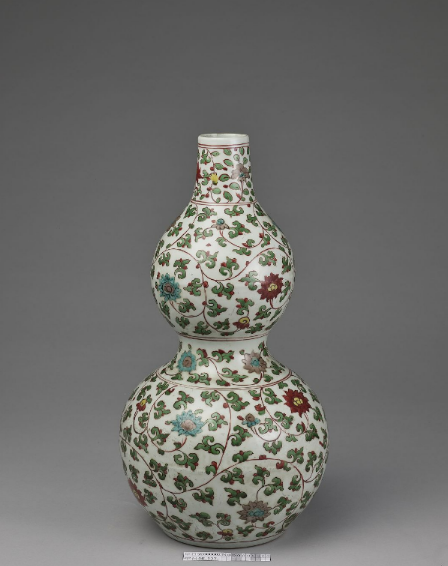
Object: Gourd-shaped vase (cat. no. 1)
The “foreign lotus” blends the Indian lotus with Persian arabesques and entered China via Indian Ocean trade. During the Jiajing-Wanli period, the opening of Macau and the Manila Galleon route facilitated the large-scale circulation of such motifs. Jingdezhen artisans reorganized these designs into symmetrical floral patterns, giving foreign forms a new aesthetic order in the Chinese context.
A Flower's Journey 🌸
This flower pattern didn't start in China! It travelled on ships all the way from India and Persia. The artists in China liked the curly leaves so much they added them to their own vases, creating a brand new style that everyone loved.
The "Foreign Lotus" (Baoxianghua) serves as a case study in motif assimilation. Entering via maritime silk routes, its Persianate arabesque structure was systematized by Jingdezhen artisans during the Ming expansion. This represents a process of 'sinicization of the exotic', where foreign visual data is reorganized into a coherent Chinese decorative grammar.
Material Encounters:
Importing and Recasting Enamel Technologies
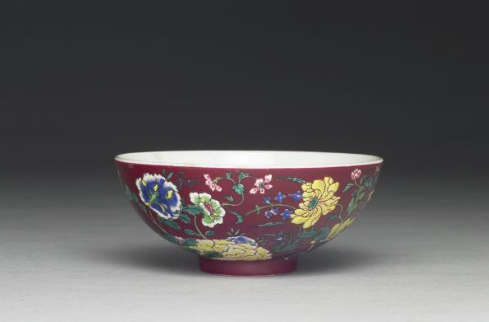
Object: Yangcai Bowl (cat. no. 4)
In the Yongzheng period, European enamel pigments were introduced into the Forbidden City. The Imperial Workshops instructed Jingdezhen to experiment with new porcelain bodies so wares could accommodate Western light-and-shadow effects while preserving Chinese floral composition. This bowl exemplifies 'material importation and stylistic reconstruction'.
New Colors from Far Away 🎨
Visitors from Europe brought new, bright paints to the Emperor's palace. The Chinese potters were very clever and figured out how to use these new paints on their bowls. They mixed Western colors with Chinese flower drawings to make something totally unique.
This Yangcai bowl signifies a technological transfer. The introduction of the colloidal gold (ruby) pigment and arsenic white (blanc-de-verre) from Europe allowed for tonal gradation previously impossible in wucai. The object embodies the Qing court's strategy of technological appropriation: utilizing Western materiality to enhance Chinese representational traditions.

A Visual Bilingualism:
Cross-Cultural Painting in the Imperial Court
Object: Vase with figure, flower and bird (cat. no. 6)
During the Qianlong reign, Western artists like Giuseppe Castiglione introduced linear perspective and light-and-shadow modeling. The imagery on the vessel becomes a form of 'visual bilingualism': Western principles of volumetric shaping placed alongside the poetic pictoriality of the Chinese tradition.
Speaking Two Art Languages 🗣️
Imagine a painting that speaks two languages at once! This vase uses Chinese style for the background and a Western style (using light and shadow to make things look 3D) for the main picture. It shows how the Emperor liked to mix the best of both worlds.
We term this aesthetic 'visual bilingualism'. The interaction between Jesuit painters and court artisans resulted in a hybrid style where Western chiaroscuro was applied to traditional Chinese subjects. This synthesis reflects the High Qing universalist ideology, encompassing both Eastern and Western epistemologies within the imperial gaze.
A Cross-Cultural Lifestyle:
Snuff and Urban Aesthetic Reinvention
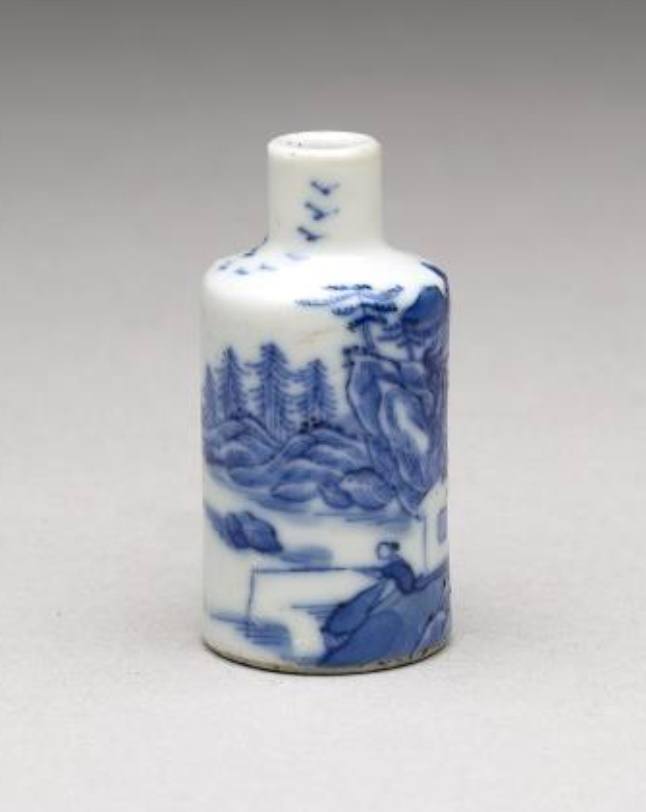
Object: Blue-and-White Snuff Bottle (cat. no. 7)
Snuff originated in Western medicinal culture and became localized as an object of connoisseurship for literati elites. In the late Qing, snuff bottles emerged as symbols of a cross-cultural lifestyle. They demonstrate the capacity of urban culture to absorb and transform foreign habits into aesthetic artifacts.
A Cool New Fashion 🎩
Taking snuff (a kind of powder) was a habit that came from Europe. But people in China made it their own by creating tiny, beautiful bottles to hold it. These bottles became like cool accessories or toys for grown-ups in the big cities.
The snuff bottle represents the 'indigenization' of a foreign consumption practice. Originally a Western import, snuff taking was re-codified by the Chinese literati. The bottle itself became a site for micro-painting and collecting, illustrating how foreign commodities are stripped of their original context and re-embedded into local social hierarchies.
Regional Networks of Exchange:
Courtly Aesthetics in Siam
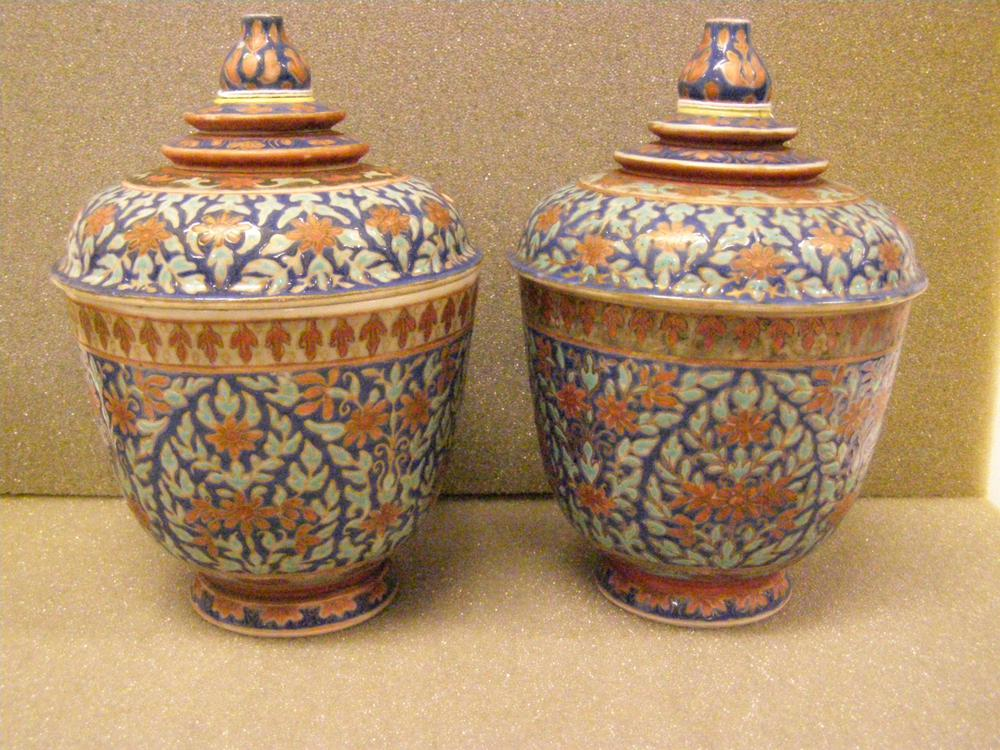
Object: Lai Nam Thong Covered Jars (cat. no. 8)
This export porcelain was commissioned by the Siamese (Thai) court. While its motifs derive from the Thai ceremonial system, the techniques were executed by Jingdezhen artisans. It embodies the bidirectional exchanges between China and Southeast Asia, where Chinese craftsmanship evolved to meet regional demands.
Made in China, Styled for Thailand 🐘
The King of Thailand wanted special jars for his palace. He sent drawings of Thai gods and fire patterns to China. The Chinese potters made the jars exactly as asked. It’s a perfect mix of Chinese skill and Thai style!
Bencharong ware ("Five Colors") illustrates the sophistication of intra-Asian trade networks. It is a product of precise customization: the form and iconography are strictly Thai (Thepanom figures), while the material production is Chinese. This reflects a 'shared courtly language' across East and Southeast Asia.
Political Aesthetics in Porcelain:
The Visual Rhetoric of Socialist Internationalism
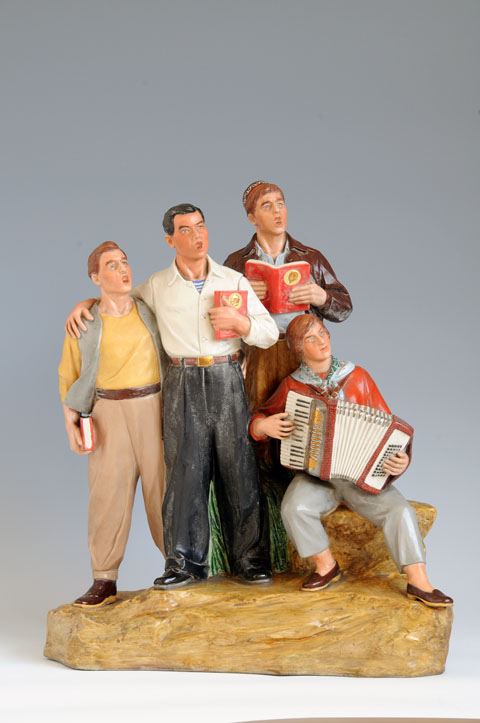
Object: 'China-Central Asia Friendship' (cat. no. 12)
During the Cold War, China used art to forge political symbolism with Central Asian countries. This sculpture embodies socialist internationalism: the youths' poses emphasize 'unity' and 'friendship'. Porcelain functions here as an instrument of political communication.
Statues of Friendship 🤝
Art can be used to make friends! This statue shows young people from different countries standing together happily. It was made to show that China wanted to be good friends with its neighbors.
In the mid-20th century, porcelain was mobilized for diplomatic propaganda. This sculpture utilizes the visual lexicon of Socialist Realism—heroic poses, dynamic composition—to articulate the geopolitics of the Cold War. It transforms the ceramic medium into a vehicle for state ideology and internationalist rhetoric.
Contemporary Co-Creation:
From Export Trade to Collaborative Practice
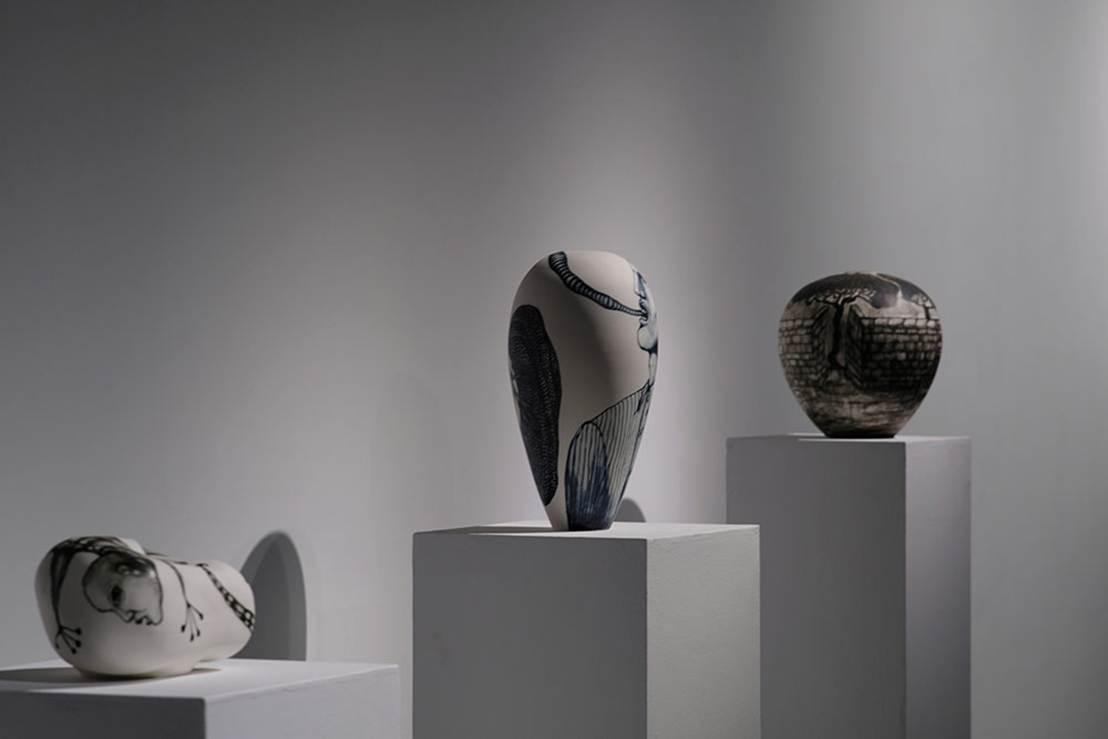
Object: Narrative Ceramics by ELICA (cat. no. 14)
This installation represents a new paradigm of collaboration. Unlike the export model of earlier centuries, this work emerges from horizontal, reciprocal creation. ELICA Studio draws on the Italian “istoriato” tradition and engages with Jingdezhen's porcelain heritage, producing a genuinely global co-creation.
Working Together Today 🌍
Today, artists don't just buy and sell; they work together! Italian artists and Chinese potters teamed up to make these funny and beautiful plates. It shows that when we share our stories, we can make something brand new.
The ELICA project marks a shift from 'commission' to 'co-creation'. It synthesizes Italian Renaissance narrative ceramics (Majolica/Istoriato) with contemporary Jingdezhen craftsmanship. This reflects the modern condition of 'Drifting Existence', where cultural identity is fluid, and production is a dialogic process rather than a linear transaction.
Cultural Exchange Epilogue · Mapping Encounters Across Surfaces
The cross-cultural journey of porcelain has never ceased.
Whether through material adaptation, visual reinvention, or contemporary collaboration, porcelain remains an open medium for global exchange. It records the movement of civilizations and reminds us that culture is never linear, but continually reshaped through encounter.
The Journey Continues... 🚀
Porcelain has been traveling for hundreds of years, and it's still going! Every cup or plate tells a story about people meeting and sharing ideas. What story will you tell with art?
In conclusion, porcelain acts as a material archive of globalization. It does not merely reflect history; it constitutes it through the circulation of signs and techniques. This 'Culture Line' demonstrates that authenticity in ceramic art is not about purity, but about the resilience of the medium to absorb, translate, and preserve diverse cultural memories.